Blogs
A First Look at AI-Assisted Site Creation in Liferay DXP 2026

David H Nebinger
For the last couple of years, most AI conversations around enterprise platforms have focused on content generation, chatbots, summaries, and assistants.
Useful? Absolutely.
But those use cases still largely leave the actual construction of digital experiences in human hands.
That’s starting to change.
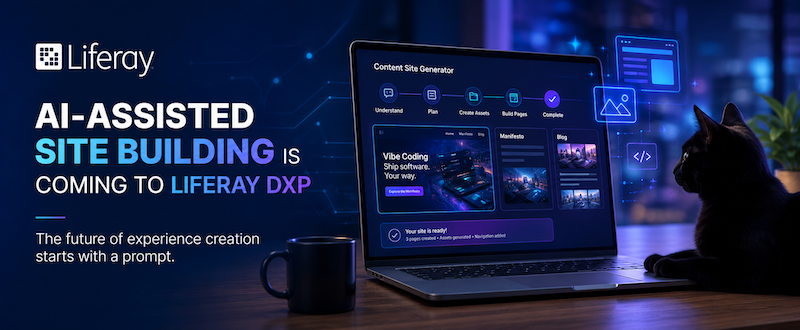
I recently got an early look at a new capability being developed around Liferay AI Hub called the Content Site Generator, and it points toward something much bigger than “AI-generated text.”

It points toward AI-assisted site creation.
Not in the sense of replacing developers or designers, but in dramatically accelerating the path from idea to working experience.
And honestly?
It’s one of the more exciting directions I’ve seen for Liferay in a long time.
Prompt-Driven Site Creation
The experience starts with a simple prompt.


In my case, I used:
Build a small site about vibe coding (the developer trend of shipping software with AI as a coding partner). Pages I want: (1) Home: a hero with punchy tagline, a short About section, and a featured posts strip pulled from the blog. (2) Manifesto: a longer take on what vibe coding is, why it matters, and how it changes the daily developer workflow. (3) Blog: Post where engineers share their AI workflows, prompts they like, and shipping stories. Include a simple top navigation and a footer. You must use images that lean into AI and technology (images of code on screens, modern dev environments).
From there, the system begins planning the site.

It determines the assets it needs to create.

It generates content.

It creates imagery.

It builds pages.

And eventually, it produces a complete working site.

What struck me most wasn’t just that it generated content.
It was that it generated structure.

This wasn’t a single AI-generated landing page. It was a multi-page experience with navigation, layout decisions, imagery, reusable components, and content relationships.
The Important Part: It Still Feels Like Liferay
One of the smartest implementation details is that the generated output is still built using standard Liferay concepts.
The generator uses:
- Out-of-the-box fragments
- Newly generated fragments when needed
- Standard page composition
- Style book-compatible components
That last point matters a lot.
Because the generated site still respects Style Books, you can completely restyle the experience later without rewriting generated code or rebuilding pages manually.
That means the AI-generated experience still participates in the larger Liferay design system instead of becoming a disconnected artifact.
This is exactly the right architectural direction.
AI should accelerate composition, not bypass the platform.
AI-Assisted Editing Inside the Page Editor
The generation story doesn’t stop after the site is created.
Inside the page editor, AI-assisted modifications can also be performed using natural language prompts.
For example:
Add a 3 column grid at the bottom with cards for the latest blogs
Instead of manually creating containers, configuring layouts, dropping fragments, and wiring content, the AI can perform the operation directly.
That changes the editing experience significantly.
Not because experienced users suddenly forget how to use the page editor, but because intent becomes more important than mechanics.
You describe the outcome you want.
The platform handles much of the assembly work.
This Feels Bigger Than “AI Features”
A lot of current AI integrations across the industry still feel like isolated tools bolted onto existing platforms.
This feels different.
This feels like AI becoming part of the actual experience-building workflow.
And importantly, it still preserves the strengths that matter in enterprise environments:
- Governance
- Reusable components
- Centralized styling
- Structured content
- Editable experiences
- Composable architecture
That combination is where things get interesting.
Because enterprise teams don’t just need AI to generate something quickly.
They need AI-generated experiences that remain maintainable after generation.
Still Early, But Very Promising
This capability is still evolving, and I expect we’ll hear a lot more about it as the year progresses.
But even in its current state, it already demonstrates where Liferay DXP 2026 appears to be heading:
- Faster experience creation
- AI-assisted composition
- Prompt-driven editing
- Intelligent asset generation
- Deep integration with existing platform architecture
It’s certainly an exciting time to be working with Liferay DXP.
And if this is where AI Hub is heading next, I think we’re only seeing the beginning.
Related Assets...
More Blog Entries...