Blogs
Modern Cloud-Native Operations for Liferay DXP in Infrastructure You Control

David H Nebinger
For years, organizations deploying enterprise platforms have been forced to choose between two extremes.
On one side is traditional self-hosting: complete control over infrastructure, networking, and security, but often at the cost of operational complexity. Teams end up manually provisioning environments, maintaining deployment pipelines, handling scaling strategies, coordinating upgrades, and building observability stacks themselves.
On the other side are fully managed cloud offerings that dramatically reduce operational burden, but may not satisfy requirements around compliance, sovereignty, infrastructure ownership, or deployment flexibility.
Many organizations today want something in the middle. They want modern cloud-native operational practices, but they also want to run in infrastructure they control.
That is where Liferay’s Cloud Native Experience (CNE) comes in.
Cloud Native Experience is a set of automation tools, deployment blueprints, and operational patterns for running Liferay DXP using modern cloud-native practices. Rather than treating Kubernetes as simply another deployment target, CNE provides a standardized operational model built around GitOps, infrastructure-as-code, automated scaling, and managed cloud service integration.
The goal is not simply to deploy Liferay into containers. The goal is to modernize how Liferay environments are operated.
Moving Beyond Traditional Self-Hosting
Traditional self-hosted environments often evolve organically over time. Infrastructure may be provisioned manually or through a collection of scripts that differ between environments. Operational practices can vary between teams. Upgrades become increasingly risky, scaling strategies become inconsistent, and maintaining operational visibility requires assembling multiple disconnected tools.
Cloud Native Experience approaches the problem differently by adopting modern platform engineering practices from the start.
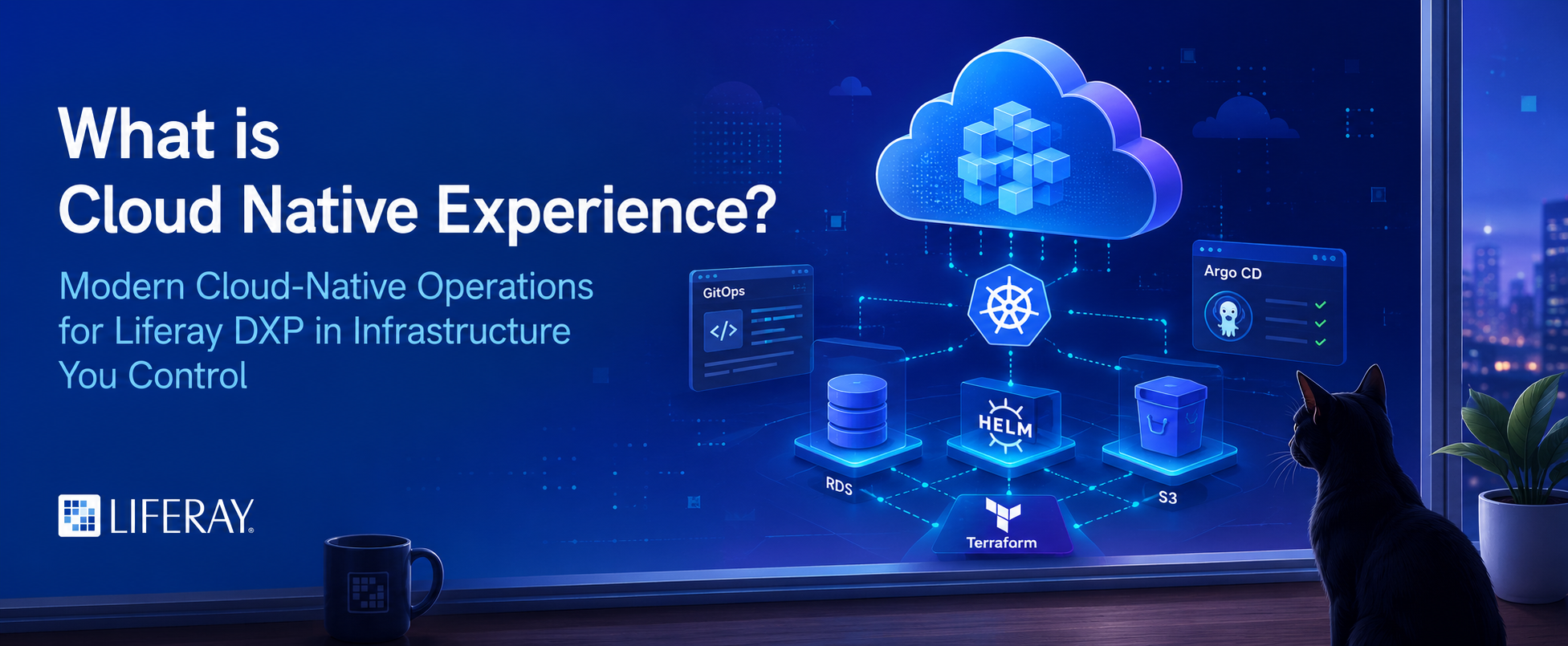
Infrastructure is defined declaratively through Terraform. Application deployment is managed through Helm charts. Operational changes are driven through GitOps workflows using Argo CD. Kubernetes provides orchestration, self-healing, and scaling capabilities. Cloud-native managed services handle foundational infrastructure concerns such as databases, object storage, and search infrastructure.
The result is a deployment model that is far more repeatable, observable, and operationally consistent than traditional self-hosted approaches.
Just as importantly, it aligns with the tooling and operational patterns many infrastructure teams are already using elsewhere in their organizations.
Two Approaches Depending on Your Needs
One of the strengths of Cloud Native Experience is that it recognizes different organizations have different operational priorities.
Some organizations prioritize portability and infrastructure flexibility. Others prioritize automation and speed to production. CNE supports both models.
The Kubernetes Ready offering is designed for teams running on any CNCF-certified Kubernetes cluster, whether on-premises, in private cloud environments, or as part of a broader multi-cloud strategy. This approach provides the core orchestration tooling and deployment blueprints while leaving infrastructure provisioning and external service integration under the control of the customer.
For organizations with strict regulatory requirements, sovereign cloud mandates, or significant existing Kubernetes expertise, Kubernetes Ready provides maximum flexibility.
Cloud Provider Ready takes a different approach. Rather than only providing application deployment tooling, it includes provider-specific blueprints that automate the entire deployment foundation. The AWS Ready toolkit, for example, provisions Kubernetes infrastructure using Amazon EKS and integrates directly with managed services such as Amazon RDS, S3, and OpenSearch.
This significantly reduces the operational overhead associated with standing up and maintaining a production-ready environment. Instead of spending weeks assembling infrastructure and operational tooling manually, teams can bootstrap a standardized deployment foundation using proven cloud-native patterns.
In many ways, Cloud Provider Ready bridges the gap between traditional self-hosting and fully managed platform offerings. Organizations retain ownership of their infrastructure and cloud accounts while still benefiting from a highly automated operational model.
Built Around GitOps
One of the most important concepts behind Cloud Native Experience is GitOps.
In traditional environments, operational changes are often applied manually or through ad hoc deployment processes. Over time, environments drift apart, and it becomes increasingly difficult to understand exactly how a system is configured.
CNE uses Git repositories as the source of truth for both infrastructure and application configuration. Changes are committed into Git and automatically synchronized into the environment through Argo CD.
This creates a deployment model that is far more traceable and repeatable. Infrastructure changes become version-controlled. Rollbacks become easier. Auditing becomes simpler. Environments become more consistent.
For many teams, GitOps ends up becoming one of the most transformative aspects of adopting Cloud Native Experience because it fundamentally changes how operational changes are managed.
Flexibility Matters
Another important aspect of Cloud Native Experience is deployment flexibility.
Not every organization can deploy into a standard public cloud environment. Some organizations operate in heavily regulated industries. Others maintain private cloud infrastructure for security or compliance reasons. Some need multi-cloud portability. Others need restricted environments such as AWS GovCloud.
CNE was designed with these realities in mind.
Organizations can deploy into their own AWS accounts, private cloud Kubernetes clusters, on-premises environments, or regulated cloud environments depending on their operational requirements. Rather than forcing customers into a single hosting model, CNE provides a consistent operational approach across multiple infrastructure strategies.
This flexibility allows organizations to modernize operational practices without abandoning their existing infrastructure standards or compliance requirements.
Getting Started on AWS
One of the most impressive aspects of the AWS Ready tooling is how approachable the initial deployment process is.
After installing the required command-line tools and configuring AWS access, teams create a GitOps repository and define a small bootstrap configuration describing the deployment environment. From there, the bootstrap tooling provisions the Kubernetes cluster, networking resources, managed services, GitOps infrastructure, and the initial Liferay deployment.
The actual bootstrap command itself is surprisingly simple:
bash <(curl -sL
  https://raw.githubusercontent.com/liferay/liferay-portal/
master/cloud/scripts/bootstrap.sh)Behind the scenes, however, the tooling is orchestrating a substantial amount of infrastructure automation. Amazon EKS, Amazon RDS, OpenSearch, Argo CD, networking resources, and the supporting platform services are provisioned and configured automatically.
The initial provisioning process can take some time, particularly while managed services are created, but the payoff is a highly standardized and repeatable cloud-native environment that aligns with modern operational best practices.
A Modern Operational Model for Liferay
Cloud Native Experience represents a significant evolution in how organizations can run Liferay DXP.
Rather than forcing teams to choose between manual self-hosting and fully managed platforms, CNE introduces a modern operational model that combines automation, GitOps workflows, cloud-native resiliency, and deployment flexibility while still allowing organizations to maintain ownership of their infrastructure.
Whether an organization wants a highly automated AWS deployment, a portable Kubernetes strategy, or support for regulated cloud environments, Cloud Native Experience provides a foundation aligned with modern platform engineering principles.
If you are interested in exploring Cloud Native Experience further, the learn.liferay.com documentation includes detailed guides for Kubernetes Ready deployments, AWS Ready deployments, GitOps configuration, bootstrap tooling, and ongoing platform management.
Cloud-native operational practices are rapidly becoming the standard expectation for enterprise infrastructure. Cloud Native Experience brings those operational patterns to Liferay DXP while still allowing organizations to deploy where and how they choose.
Related Assets...
More Blog Entries...